
Security Council
(Global Council for Safety and Protective Measures)
The Executive Board
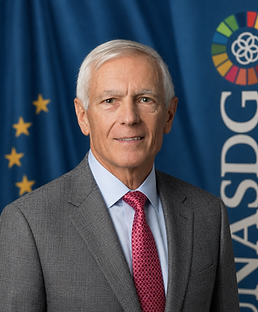
Gen. Wesley K. Clark (ret.)
Hon. Chairman

Senator Glenn Hill
CEO

Senator Dr. h.c. Pat Meyer
President

Senator Hans Pflanz
Vice President

Hon. Dr. Kathleen Robertson
Senior strategic advisor
Strategic Team

Hon. Mr. Johann Marx
Special Ambassador
Political Relations

Hon. Mr. Tom Marx
Special Ambassador
Compliance & Intelligence

Senator Johan Obdola
Special Ambassador
Cybersecurity and Intelligence

Hon. Mr. Don Lahoucine Goghrod
Special Ambassador
International Police Relations

In order to uphold appropriate national security standards, and with the participation of Gen. Wesley Clark as well as international security experts, including Glenn Hill, and the President of the Senate, Dr. h.c. Patrick Meyer, the UnASDG Senate unanimously resolved to establish the UnASDG Security Council with effect from 24 November 2021. On 1 December 2025, the Council was formally expanded and is henceforth designated in its full name as the Global Council for Safety and Protective Measures (GSP).
The GSP, in close coordination with the Senate and in cooperation with relevant national and international institutions and agencies, contributes to the orderly implementation of baseline requirements for establishing security frameworks and operational security structures. This includes, in particular, the protection of persons and life, as well as the safeguarding of resources, assets, technologies, and mission-critical means deployed for the realization of projects and missions agreed with partner States at both national and international levels.
In furtherance of this mandate, the GSP engages with competent national and international security services, financial institutions, and implementation partners to support compliance with agreed procedures and to facilitate the faithful execution of applicable conventions and intergovernmental arrangements. These efforts are directed toward advancing the Sustainable Development Goals (SDGs) adopted by 193 Member States at the United Nations General Assembly on 25 September 2015 in New York City.
With the support of international experts from the banking sector, security services, public policy, business, and the information technology domain, a dedicated urban development security program—CITYGUARD—was developed for this purpose. CITYGUARD provides comprehensive security protocols and operational guidance, including tailored monitoring mechanisms for planning and development, the provision and application of funds, and targeted protective measures. These safeguards are designed to be instituted prior to the commencement of implementation under relevant programs and initiatives—particularly the UnASDG Cities Global Initiative and the ICCDR Crisis and Disaster Response Initiative (ICCDR).
The objective is to guide all participating parties safely and effectively through implementation to completion, to strengthen project assurance, and to support that allocated funds are utilized strictly in accordance with agreed purposes and deployed in line with the governing agreements.

CITIGUARD©
CitiGuard serves as the certification, governance, and compliance framework of the UnASDG Cities Global Initiative, designed to establish secure, transparent, and internationally aligned structures at city and program level. Its purpose is to protect all stakeholders by ensuring that financing, implementation, and payment processes for projects, programmes, and initiatives are auditable, resilient, and consistently applied.
In its preliminary stage, CitiGuard supports governments, intergovernmental organizations, institutions, organizations, and other partners and members in building reliable investment and implementation architectures worldwide. This includes the adoption and operationalization of internationally recognized standards and frameworks to strengthen transparency, accountability, and integrity across planning, funding, delivery, monitoring, and reporting.
CitiGuard further enables SDG-, ESG-, and CDR-aligned certification pathways, supporting eligibility and readiness for sustainable financing mechanisms within the UnASDG Cities framework. A key pillar is the establishment of secure payment processing and settlement structures for development programmes, based on the latest financial messaging and interoperability standards, including ISO 20022, implemented in cooperation with regulated banks, payment service providers (PSPs), and financial institutions (FIs). These mechanisms are intended to reduce friction, strengthen compliance, and standardize best practices—thereby simplifying future development execution in a sustainable and scalable manner.
The initiative also includes a structured test phase of the global programme to confirm that participation requirements—whether for the SDG Cities programme or for the funding of national development agendas—are fully aligned with the Sustainable Development Goals (SDGs) and with internationally adopted standards for crisis and disaster protection across the full lifecycle (prevention, acute relief, and reconstruction). Where applicable and subject to country-specific design, CitiGuard supports the transparent implementation of social-impact distribution models, including pathways for universal basic income (UBI) in accordance with each country’s individual plan and governance approach.
